Binance Hack: $3.3 Billion Drained From Hot Wallets, Are User Funds SAFU?
$3.3 billion left Binance hot wallets in 40 minutes and $1.8 billion was frozen. What happened, how the SAFU fund works and what users should do now.
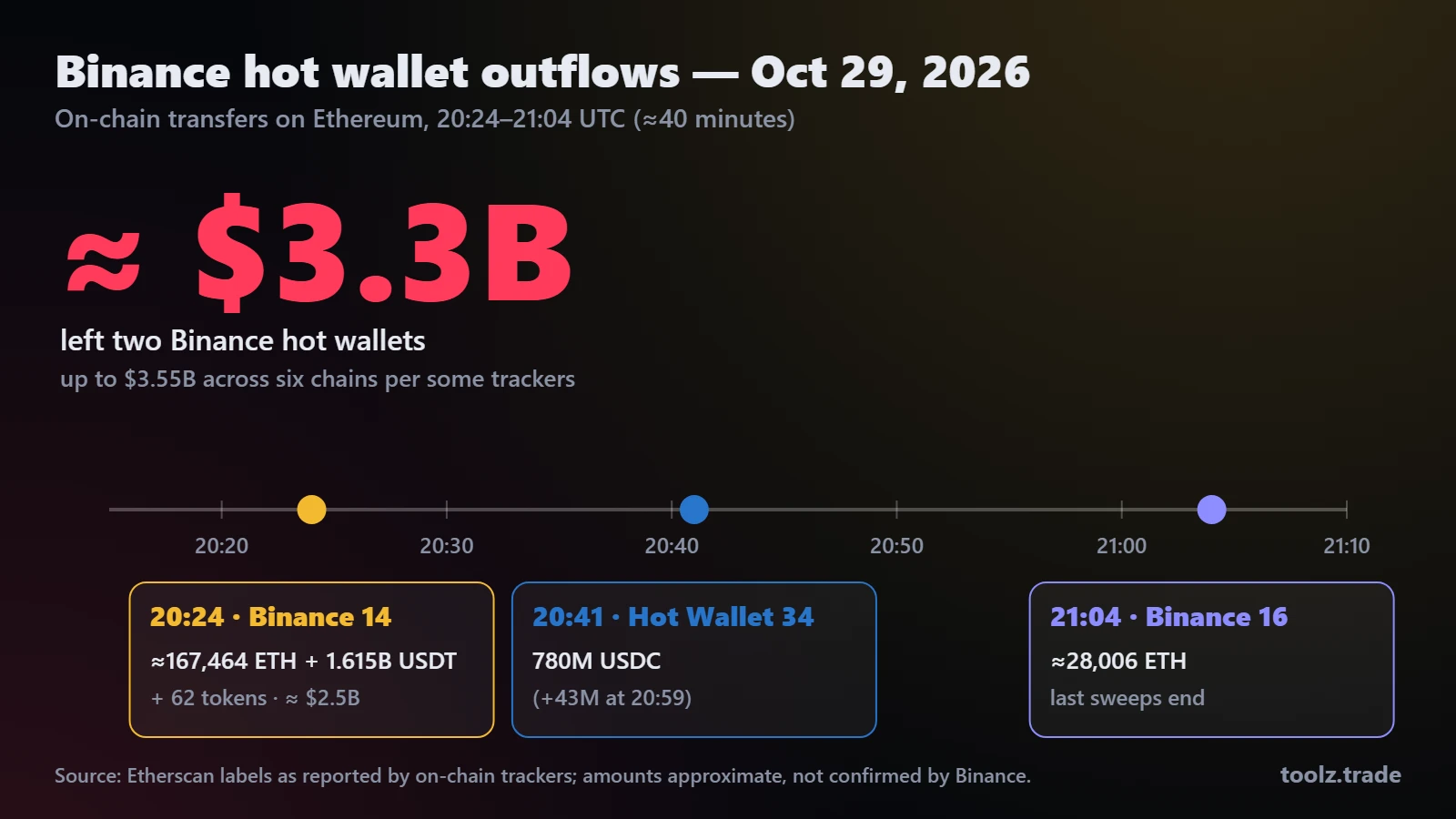
Binance, the world's largest cryptocurrency exchange, found itself at the centre of one of the biggest security incidents in crypto history on the evening of October 29, 2026. According to on-chain data, about $3.3 billion worth of crypto assets left two of the exchange's hot wallets on the Ethereum network within roughly 40 minutes. Some trackers following six blockchains put the total movement as high as $3.55 billion. Binance has not officially declared a breach, but its founder Changpeng Zhao (CZ) wrote that the incident "appears to be a hack".
If confirmed, the attack could become the largest exchange hack in crypto history, surpassing the roughly $1.5 billion in ETH stolen from Bybit in February 2025. So what exactly happened, are user funds safe, and what does Binance's famous "Funds are SAFU" promise really mean?
$3.3 billion in 40 minutes: the timeline
According to FinanceFeeds, which cited Etherscan records, it all started at 20:24 UTC. The hot wallet labelled "Binance 14" sent about 167,464 ETH, 1.615 billion USDT and 62 other tokens, roughly $2.5 billion in total, to a new address in a single transaction. At 20:41, 780 million USDC left the wallet named "Hot Wallet 34", followed by another 43 million USDC at 20:59. About 28,006 ETH was also moved out of the "Binance 16" wallet. Smaller sweeps continued until 21:04.
Etherscan labelled the sending address "Binance Hot Wallet Exploiter" and the receiver "Binance Hot Wallet Exploiter 2". Within a short time the receiving address began splitting about 195,460 ETH (around $445 million) and 1.2 billion USDT across new addresses.
What did Binance and CZ say?
The exchange's first statement was cautious. According to Crypto Briefing, Binance said its security team was "looking into reports of a potential security issue" and that it had not confirmed any impact on user funds at this stage. Binance co-founder and head of customer service Yi He also said the teams were actively investigating, warned users about scammers and stressed that funds are "SAFU", meaning safe.
Changpeng Zhao wrote on X at around 21:15 UTC that the incident looked like an attack, said user funds were safe and added that, as a shareholder, he expected all user losses to be fully covered. It is worth remembering, however, that CZ stepped down as CEO in 2023: his words are an expectation, not a formal commitment from the exchange.
How did the attack happen?
The exact method has not been disclosed, but the on-chain trail offers some clues. The address that triggered the transfers had been funded a day earlier, on October 28, through the mixing service Tornado Cash, which hides the origin of funds. Hours before the incident the same address deployed a "sweep" smart contract. At 20:20 the Binance 14 wallet appears to have delegated to that contract's code through Ethereum's EIP-7702 feature. This feature lets a normal wallet temporarily behave like a smart contract, which suggests the attacker somehow gained the wallet's signing authority.
Binance had announced scheduled Ethereum wallet maintenance for October 28, so in the first minutes there was speculation that the outflows could be part of that maintenance. The Tornado Cash link and the "exploit" labels, however, weakened that explanation. There is no verified information yet on who is behind the attack.
Tether and Circle froze $1.8 billion
The most striking part of the incident was the quick reaction of stablecoin issuers. According to CZ's thank-you message, Tether froze about $971 million in USDT and Circle froze about $823 million in USDC. That put roughly $1.8 billion of the stolen assets out of the attacker's reach.
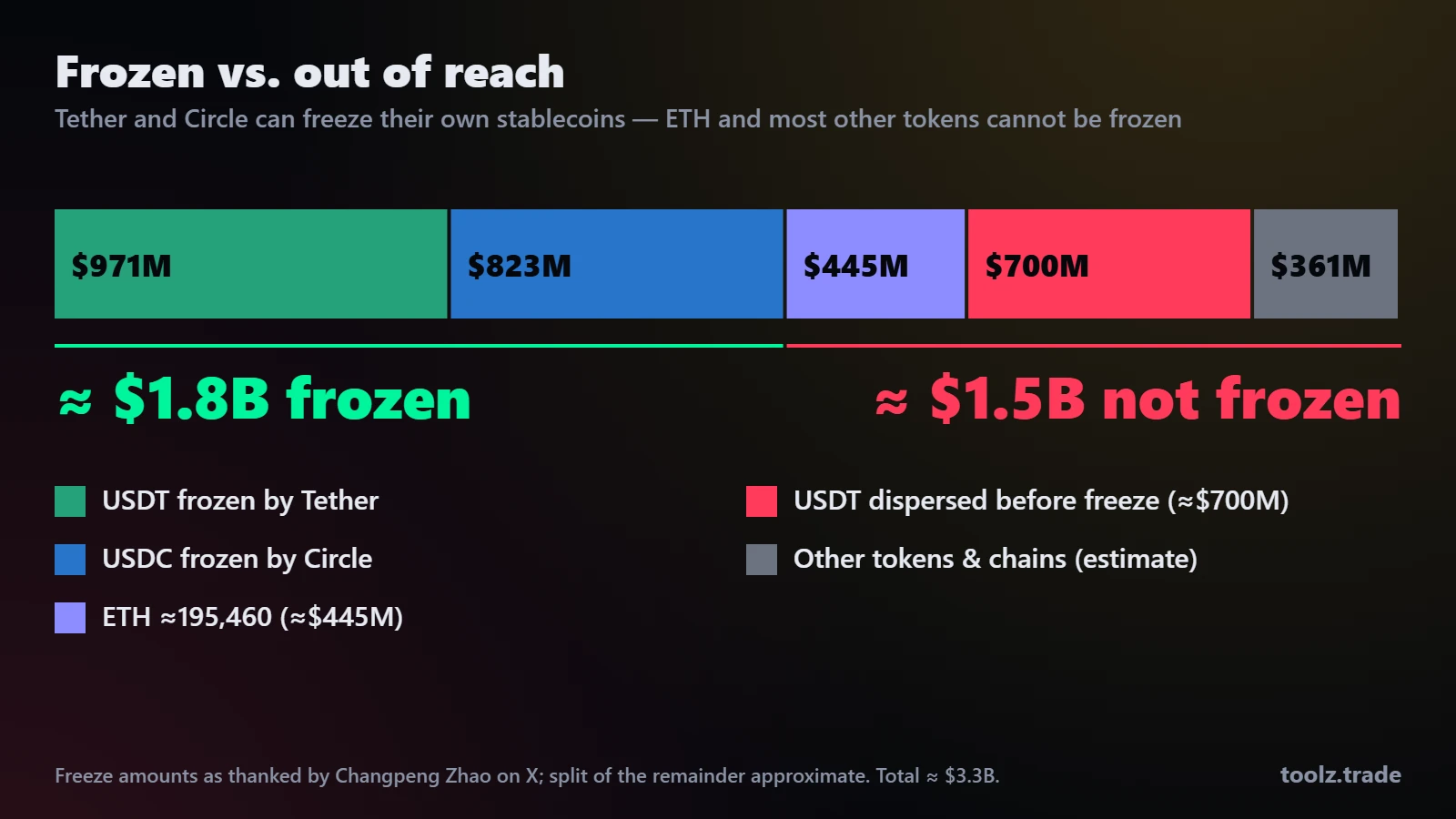
Not everything could be saved, though. About $700 million in USDT had already been dispersed to new addresses before the freeze. Most of the Ethereum (ETH) and other tokens cannot be frozen by a central issuer at all. FinanceFeeds estimates that more than $1.1 billion remains beyond the reach of any freeze. Large wallet movements are being watched closely to trace the funds.
"Funds are SAFU": what is Binance's SAFU fund?
The phrase "Funds are SAFU" grew out of the "funds are safe" reassurance CZ repeated whenever the exchange had a problem, and in 2018 it became one of the best-known jokes in crypto. That same year Binance set up an emergency fund named after it: SAFU, the Secure Asset Fund for Users. The fund was initially fed with part of the trading fees and is held to cover user losses in extraordinary security incidents.
SAFU's best-known test was the May 2019 attack. Back then about 7,000 BTC was stolen from a hot wallet; Binance covered the loss from the fund and no user's balance was reduced. In January 2026 the exchange announced it would convert the roughly $1 billion in stablecoin reserves held in the fund into Bitcoin, and it completed the conversion in February. According to Binance, the fund now holds 15,000 BTC, worth about $1.2 billion at current prices. The exchange has pledged to top the fund back up to $1 billion from its own treasury if its value falls below $800 million.
Two points matter here. First, using SAFU is at Binance's discretion. The fund is meant for the exchange's own security incidents, not for losses caused by user mistakes, scams or phishing. Second, the roughly $1.5 billion that could not be frozen exceeds the size of SAFU. Any compensation may therefore have to come not only from the fund but also from Binance's own reserves. The exchange has not yet said whether it will use SAFU.
Market reaction: BNB fell sharply, liquidations surged
As soon as the news spread, a wave of selling hit the market. Binance's own token BNB dropped from about $745 before the incident to $680, a loss of 8.7%. Over the same hours Ethereum fell 4.4% and Bitcoin 3.2%, briefly dipping below $78,300.
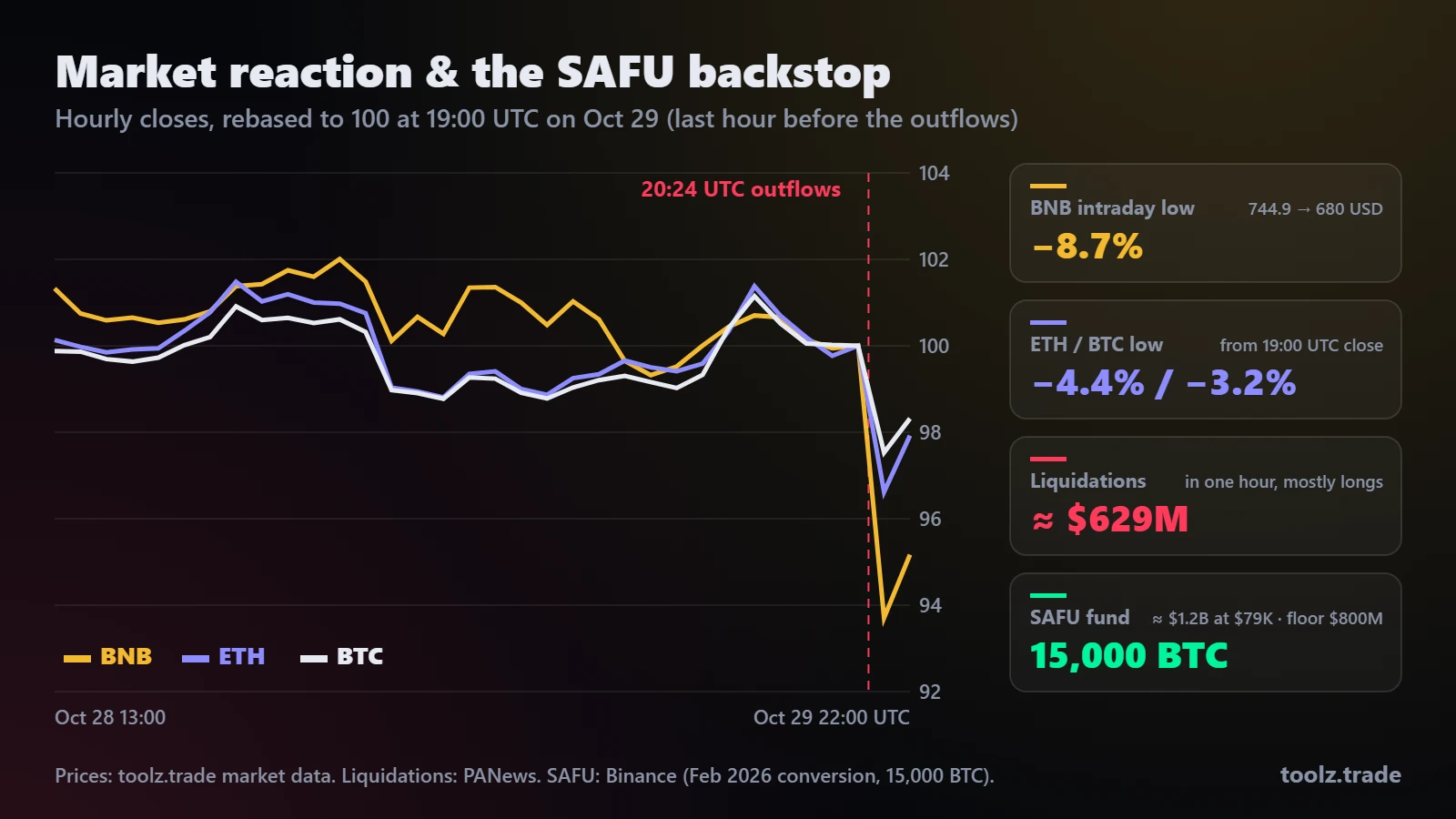
According to PANews, about $629 million in leveraged positions were forcibly closed within an hour, almost all of them long positions. We explained in our liquidation guide how sudden drops set off chain reactions in leveraged trading. You can follow the latest liquidation data on our crypto liquidations page. Prices recovered part of their losses after 21:00 UTC.
What should Binance users do now?
- Trust only official channels: fake "refund" and "account verification" sites multiply quickly after incidents like this. Yi He specifically warned users about scammers.
- Do not trade in a panic: Binance has not said that user balances were affected. Hasty selling in moments of thin liquidity can magnify losses.
- Review your security: check two-factor authentication, your withdrawal address whitelist and your API keys.
- Spread custody risk: keeping part of your long-term holdings in a wallet you control reduces dependence on a single exchange.
What is still unknown
The exact amount lost, the method and the perpetrator, whether withdrawals were paused, whether the frozen stablecoins will be returned to Binance and whether the SAFU fund will be used are all still unclear. Figures also differ between sources: estimates for the outflow range from $2.5 billion to $3.55 billion and for liquidations from $450 million to $629 million. The picture may change as Binance publishes a detailed statement. You can follow developments in our crypto news section.
This report was prepared by comparing coverage from FinanceFeeds, Crypto Briefing, Bitcoin Sistemi, The Block and Cointelegraph with Etherscan on-chain records and PANews data. Price data is toolz.trade market data. Not investment advice.